
Tags
Bodily Autonomy?, Control, Cultural Decay, Dogma of Death, Euphemism Treadmill, Euthanasia, Family Planning?, MAiD, Medical Assistance in Dying, PAD, Physician assisted death, Physician-assisted Suicide, Suicide, Tell them to stay
We are perambulating through a semantic swamp on what psychologist and linguist Steven Pinker artfully terms, “the euphemism treadmill”. Once acceptable terms used just a few years ago may have been displaced by newer code words.
“The reason for this rolling semantic renewal,” writes John McWhorter, professor of linguistics at Colombia University, “is that the meanings of words are, in actual usage, messier than their dictionary definitions.” He writes that the euphemism treadmill is “a symptom of the fact that, however much we would like it to be otherwise, it’s easier to change language than to change thought.”
An example he uses is when he worked with a magazine about family planning. He came to understand that the term referred to contraception and abortion, not just people “planning” to have children. “Why the obliqueness,” asks McWhorter? Clearly to euphemize the less savoury idea of birth control by eliminating an otherwise healthy fetus being carried by an otherwise healthy potential mother.
Euphemisms by any other Name
All this to bring us to the euphemism by any other name: (with apologies to Shakespeare’s “a rose by any other name would smell as sweet”), a person seeking to be euthanized still smells of decay. The problem with the shifting ground of this class of euphemism is that it furnishes a false narrative of the meaning and dignity of life, while undermining the role and value of community of relationships of the person who has lost hope in the meaning and dignity of one’s own life; it is a cultural decay we are witnessing in real time.
Garifalia (Lia) Milousis, a young university student who attempted suicide seven times, said “it takes intervention, it takes relationships, it takes work, but there is hope”:
I’m the future version of myself who survived to tell you this… Those living with mental illness don’t need someone to tell them how to die; they need someone to tell them to stay.
Words like mercy killing, euthanasia, PAD (physician assisted death), and the current euphemism of MAiD (medical assistance in dying), all betray a suicidal society bent on killing itself in the name of personal choice and the refusal to give up control, as B. Jamieson writes in Everything is Never Enough:
We especially want to control life itself, to tame the intolerable unpredictability of how it begins and ends. Why has euthanasia gained so much popular support and legal sanction in the West in recent decades. Because certain suffering of uncertain depth and length conflicts with the dream and demand of control…
Suicide – including all its euphemistically named, medically abetted varieties – does not control death; it only succumbs to death’s control. Surrender is not victory.
Canada among world leaders in Physician Assisted Suicide
Why Canada is second (4.7% of all deaths) only to the Netherlands (5.5%) in physician assisted suicide/capita is troubling as it is bewildering. But in Canada, Quebec far exceeds the national average with the highest rates (7.2%) in the world. What started off decades ago as perhaps a “treatment” for those near death and who are in unmitigating pain, now find the guardrails being bent to breaking in the current debate of widening the criteria to include people with mental illness in the ever lengthening list of those who would “qualify” for MAiD.
Stephanie Taylor reported:
“Assisted dying has been legal in Canada since 2016, following a 2015 Supreme Court of Canada ruling that struck down the prohibition against a doctor assisting someone end their own life. Thus a criterion was introduced that required someone being able to seek an assisted death was that their natural death had to be ‘reasonably foreseeable’.
Following a 2019 court ruling in Quebec that found that criteria to be unconstitutional, the federal government amended the law in 2021 to remove the requirement and put into place a sunset clause for when the prohibition would eventually lift for individuals seeking an assisted-death solely on the basis of suffering from mental illness.
Since then, a fierce debate has erupted over the impacts of Canada’s widened criteria and whether the federal government ought to move ahead with lifting the mental illness exclusion.
Proponents of removing that prohibition, such as Dying with Dignity Canada, argue not allowing those living with mental suffering to be able to have the same access to an assisted-death as those living with physical suffering infringes on their Charter rights.
Meanwhile, groups of psychiatrists say that determining whether someone suffering from a mental illness will never recover is near impossible. Other disabilities and mental health advocates warn that expanding eligibility puts already vulnerable persons at further risk and argue that the government’s focus should instead be on providing them with the necessary supports.”
It’s one thing to consider a humane way to deal with people near death and in anguish, it is another to look for ways to legitimize suicide by any other name. Fortunately the Parliamentary Committee on the matter decided to continue to exclude the mentally ill from gaining access to MAiD, but the trend has been astronomical, and disturbing. Critics of MAiD say that the exponential growth is evidence of something going wrong.
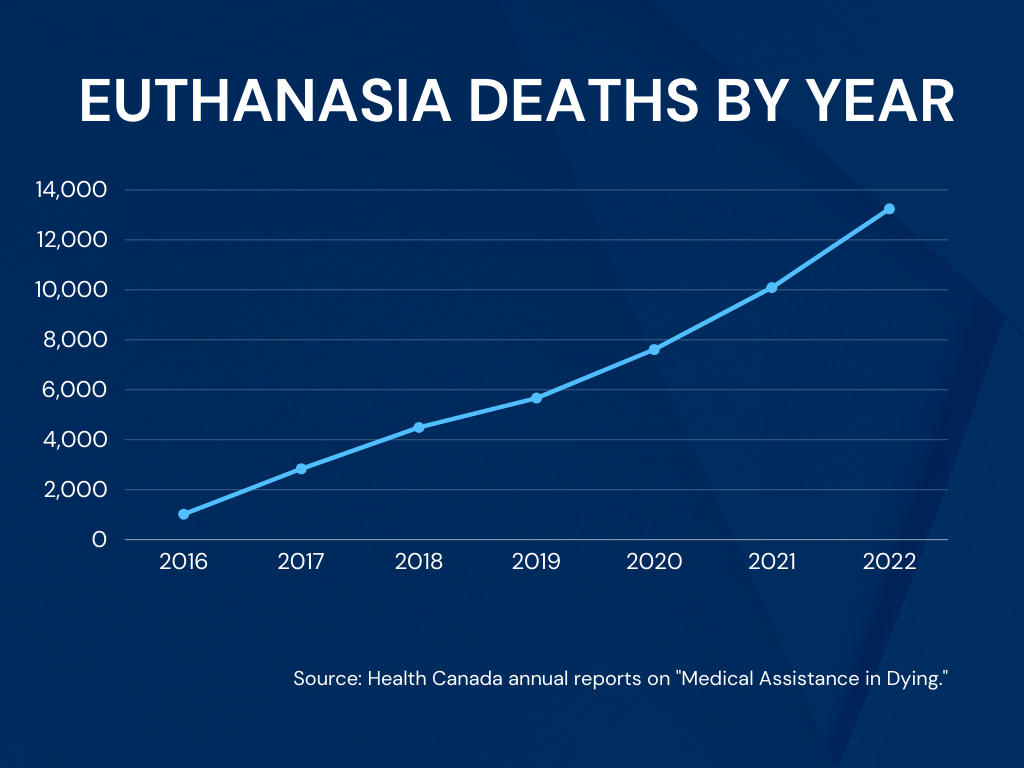
Health Canada Annual Report on Medical Assistance in Dying
Can a Lone Voice be heard amidst the Roar of Death?
Of course there is an outcry against what I am saying. People like Senator and Sociologist Kristopher Wells speaks from a moral compass that spins on the axis of bodily autonomy. He asks “What right does the state have to withhold this legitimate right [to Maid] from the mentally ill?”
The crux of contemporary attitudes to MAiD is the notion of bodily autonomy that also legitimizes abortion for any reason at any time. Abortion was once restricted to those with a pregnancy as a result of rape, or where the pregnancy would lead to a foreseeable imminent danger to the mother. Today, under the ideology of bodily autonomy, abortion can be chosen for any reason, almost at any time – since this used to be restricted to the first trimester of fetal development. Some may be shocked to hear that some Medical Ethicists believe that full term abortion is not considered infanticide. Such is the slippery slope of euphemisms that modernity slithers down.
Questions for You:
Perhaps you have not yet questioned the current dogma of death. It is too easy to float along the changing cultural norms and not notice that a profound shift has taken place.
Whatever euphemisms by any other name you may employ to mask the decay of taking your own life – let me ask you:
Is this the Society of Death you want to Live in?
Have you been observant and mindful of the recent cultural embrace of medically sanctioned suicide as it has influenced your own imperceptible acceptance?
Do the Euphemisms for Euthanasia and the massive cultural shift toward death by suicide prompt you to consider ending your own life on your own terms?
For more on Suicide Prevention:
See Suicide Prevention Canada – or call your nearest Suicide Crisis Hotline at 9-8-8.
Post Script:
Essays of this nature take enormous intellectual geography and a wide emotional bandwidth. Though I do not boast having either the intellect or the medical acumen, I am nevertheless careful to write as a slipstream against the current modern dogma of death. I welcome informed debate and discussion.
Further: if anyone thinks I am untouched by enduring those who are dying and in pain, please refer to my personal experience in: Euthanasia and Physician Assisted Suicide in Canada.
This is more enigma than dogma.
 More Enigma Than Dogma
This is very well written. I think people from all faiths need to carefully consider the implications of where this is taking us, especially in Canada.
LikeLike
Thanks Dan. It is astonishing to me that some Christians in particular do not have a well developed theology of the Sovereignty of God, a theology of life & death, or a theology of suffering that stands up to this culture decaying under the dogma of death. The West in particular is so hyper-individualistic that it is blind to the mystery of life and death in Christ.
LikeLiked by 1 person
Thank you for both articles, Rusty. Some hard research here and speaking from your personal experience. The ‘slippery slide’ is a world-wide phenomenon. In one of his last interviews Dr. Martyn Lloyd-Jones, Harley Street specialist and theologian, compared our world to one “gone completely mad!” That’s what happens when we shut out the living God and his Christ. Greetings from Africa.
LikeLike
Thanks Erroll, it takes so much out of me to speak to these issues – but as I said – it must be said against the current of our times. As Christian faith descends in the West, so do redemptive ethics decay. For such a time as this to be salt and light my friend. Grace to you from such great a distance.
LikeLike
The Lord’s own strength to you in your needed writing ministry, Rusty.
LikeLike
I so appreciate your hard work and research that puts so much helpful language around this issue. I will be sharing this with friends. Thank you!
LikeLike
Thanks for the encouragement. May your friends be edified.
LikeLike
Hi Rusty, I appreciate your willingness to write on these topics. Its a slippery road for sure and it does not take much time to find our cultural viewpoints to be present in the church. Phil
LikeLike
I have found in conversations that people tend to have simply been carried in the current of post-modern thought on this topic – without reflecting on the implications of individuality – or hyper-individuality – being the overarching ethic of our day. In a culture that is increasingly drifting from a Judeo-Christian worldview, this is where people have arrived: without a sense of their worth relationally, or their worth to the One who made us for Himself.
LikeLike